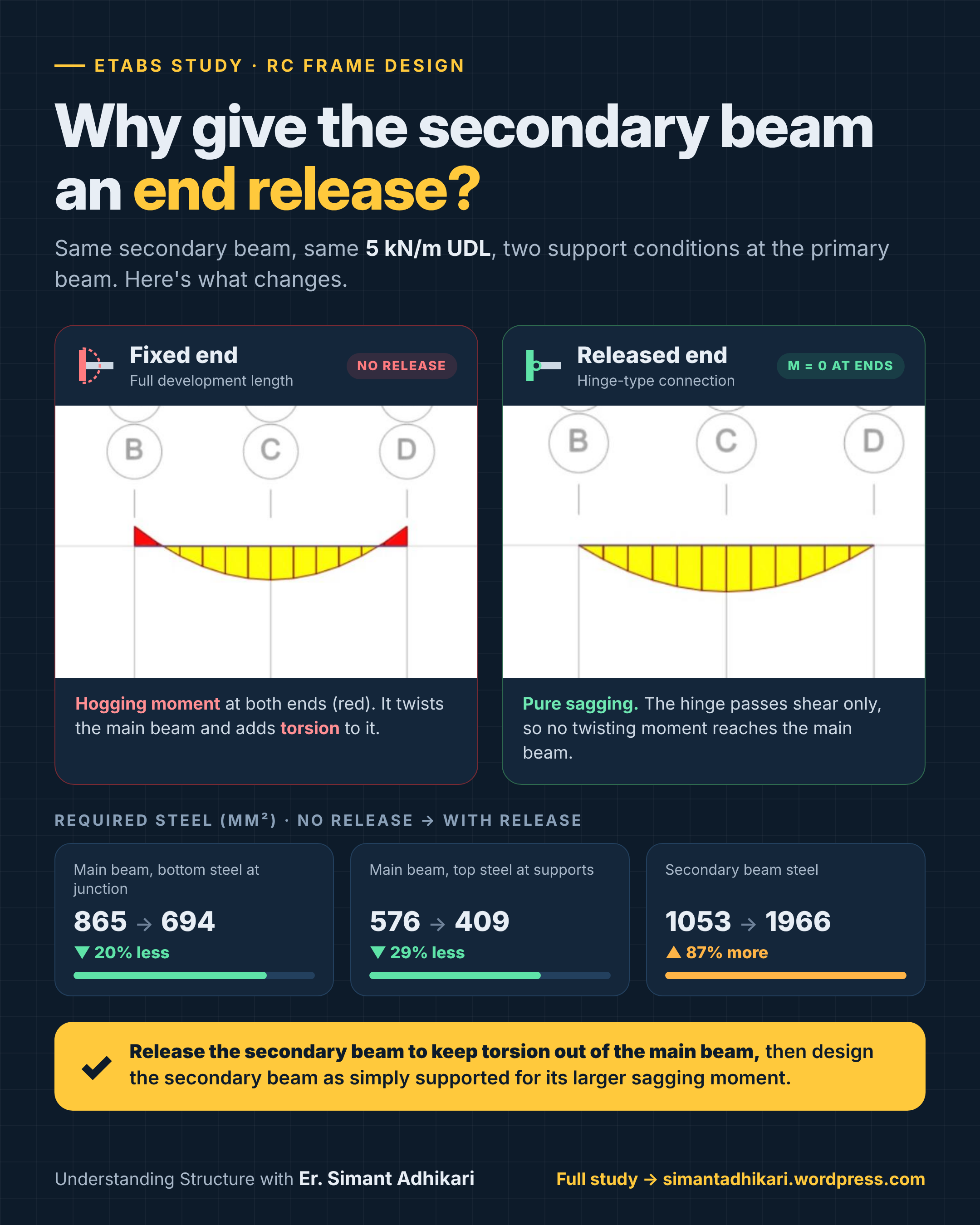
Study on the essence of providing end release to a secondary beam
Abstract
This study compares two secondary beams with the same dimensions and the same loading. One of them has an end release at its connection with the primary beam; the other does not.
Both beams are modelled and analysed in ETABS as secondary beams framing into primary beams.
Introduction
The design of a framed structure rests on how load travels from one element to the next. As it moves, the load can produce different effects in each element. Load resting on a secondary beam is passed to the main beams that support it.
If the connection between the two beams is made fixed by providing full development length, the deflection of the secondary beam produces a twisting moment in the main beam. That twisting moment adds torsion to the main beam, and the main beam then needs a larger section. A sound design procedure should therefore stop hogging moment from developing at the ends of the secondary beam.
Releasing the secondary beam at its connection with the main beam gives only partial fixity at the joint and keeps the extra torsion out of the main beam.
Comparative Analysis
Two secondary beams are modelled and a UDL of 5 kN/m is applied to each.


Both models are analysed and their bending moment diagrams plotted.


The reinforcement each section needs under this load is then calculated.


Required steel (mm²), no release → with release:
Conclusion
- With no release at the secondary beam, the main beam carries torsional moment on top of the moment from its own loading.
- With an end release, a hinge forms at the connection, so the main beam picks up no extra moment from torsion.
- An end release can be achieved in practice by not providing full development length at the connection.
- With the release, the reinforcement demand drops for the main beam but rises for the secondary beam.